The passenger was partly sucked out of the aircraft after a window dislodged shortly after takeoff in Greece.
The Boeing Company is an American multinational corporation that designs, manufactures, and sells airplanes, rotorcraft, rockets, satellites, telecommunications equipment, and missiles worldwide. The company also provides leasing and product support services.
| Revenue (TTM) | $92.18B |
| Gross Profit (TTM) | $4.45B |
| EBITDA | $-3.26B |
| Operating Margin | 1.72% |
| Return on Equity | 170.00% |
| Return on Assets | -2.07% |
| Revenue/Share (TTM) | $119.96 |
| Book Value | $7.59 |
| Price-to-Book | 29.65 |
| Price-to-Sales (TTM) | 1.91 |
| EV/Revenue | 2.209 |
| EV/EBITDA | 27.80 |
| Quarterly Earnings Growth (YoY) | -68.00% |
| Quarterly Revenue Growth (YoY) | 14.00% |
| Shares Outstanding | $788.30M |
| Float | $756.43M |
| % Insiders | 0.05% |
| % Institutions | 75.42% |
Volatility is currently contracting

The passenger was partly sucked out of the aircraft after a window dislodged shortly after takeoff in Greece.

Two recent incidents regarding a Boeing 737 MAX aircraft have put Boeing Co. NYSE: BA stock back in the spotlight, and not in a good way. Both incidents occurred on Southwest Airlines NYSE: LUV jets.

Indonesian state energy firm Pertamina [RIC:RIC:PERTM.UL] said it has signed a memorandum of understanding (MoU) with U.S. planemaker Boeing to explore opportunities in developing a sustainable aviation fuel (SAF) industry in the country.

Recently, Zacks.com users have been paying close attention to Boeing (BA). This makes it worthwhile to examine what the stock has in store.

Passengers are paying more to fly, but the carriers selling those tickets are not necessarily the ones collecting the profits. Facing rapidly aging fleets, operators are incurring higher maintenance bills.

Boeing has launched a fourth 737 MAX assembly line in Everett, significantly expanding production capacity and supporting a multi-year ramp-up. The current 737 MAX backlog supports monthly production rates of 72–80 units, yet BA is producing at just 42, indicating strong latent demand. By 2035, 737 MAX program revenues could exceed $53 billion annually, with cumulative revenues boosted 10% by an accelerated ramp-up on the new line.

The latest government data reveals that U.S. airlines spent $6.66 billion on jet fuel in May 2026.

BA outpaces its industry as defense wins, liquidity and earnings growth support its long-term outlook despite a sizable debt burden.

Lockheed Martin (NYSE: LMT | LMT Price Prediction) and Boeing (NYSE: BA) both posted Q1 2026 results that read like two different industries.

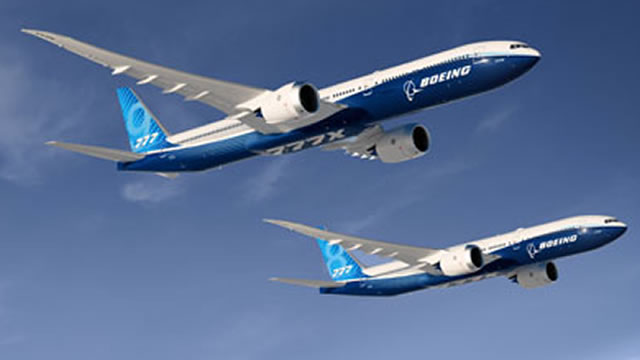
Boeing offers a compelling turnaround story, with Wall Street and Seeking Alpha Quant Ratings both issuing a 'BUY' despite current valuation concerns. BA's growth is underpinned by operating leverage, excess production capacity, and a robust backlog, especially as regulatory bottlenecks clear for the 737 MAX 7/10 and 777X programs. Future revenue could reach $130B+ by 2028–2030, with normalized net margins potentially restoring annual net profit to $13B as production scales.